Strange Land Book Club Episode 6: Are You There God? It’s Me, Margaret
A pivotal moment in the legal framework of censorship in the United States occurred in 1873 with the Comstock Act, which banned any literature that could be deemed as sexual, even indirectly. The Act prohibited the distribution of such printed materials through any channels, including via the post office, and violations could be met with steep fines and even prison time. This law included a provision banning contraceptive devices or even mention of such devices in printed materials. Some famous cases that challenged the Comstock Act included the “Hatrack” case of the late 1920s, and an ACLU case in 1933 that successfully argued for the right to import and distribute James Joyce’s Ulysses in the United States.
Since the 1950s, the Supreme Court has heard many cases that would further define and differentiate standards of obscenity in printed materials. However, in 2025 the Comstock Act is still an extant law – and continues to pose a threat not only to the sale and distribution of printed materials but to the accessibility of contraceptives.
For those of us interested in the publication and distribution of printed materials, censorship is salient topic. This is why the next few episodes of our podcast will be dedicated to banned books and censorship.
In Strange Land Book Club Episode 6, we discuss Judy Blume’s Are You There God? It’s Me, Margaret. Published in 1970, the book faced criticism, bans, and challenges from the minute it hit bookstores and libraries. Even the primary school that Blume’s own children attended refused to include it in their collection. This book makes a good example of a fairly typical banned/challenged book because of its point of view: an 11-year-old girl facing the challenges of her changing body. More than that, the book examines her exploration of religion in a household with no fixed belief system due to the different backgrounds of Margaret’s parents. If we think of these themes in relation to the Comstock Act: menstruation, sexuality, young girlhood – it’s particularly easy to see how it becomes a challenged book. However, banning such books doesn’t prevent young women from having similar experiences, thoughts, and struggles. As Judy Blume herself said in a 2023 Guardian article:
“I mean, there’s a group of mothers now going around saying that they want to protect their children. Protect them from what? You know, protect them from talking about things? Protect them from knowing about things? Because even if they don’t let them read books, their bodies are still going to change and their feelings about their bodies are going to change. And you can’t control that. They have to be able to read, to question.”
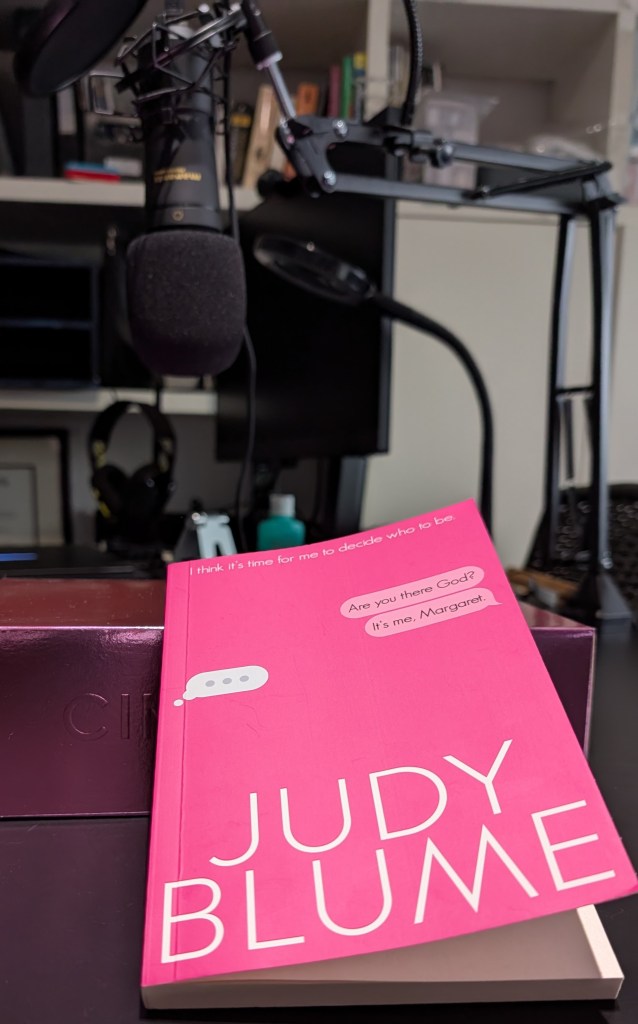
Are You There God? It’s Me Margaret will also be the topic of the last in a series of lectures of the Banned Books Network Münster (BBNM), a collaborative effort of English Department Chairs at the University of Münster to discuss challenged books in the United States. From their website:
“Our purpose is to raise awareness of the increase in book banning, and to create space for engagement with banned books and the wider repercussions of these bans. Our events are inclusive in nature, and we hope to engage students, teachers, colleagues and the wider reading public with our initiative.”
The next lecture will be on October 23rd, where Dr. Sarah Pyke will discuss Annie on My Mind by Nancy Garden. Are You There God? It’s Me, Margaret will be the featured book for Dr. Corinna Norrick-Rühl’s lecture on December 11th.
In two weeks we will release our interview with Dr. Jennifer Gouck, who gave a BBNM lecture on The Hate U Give, by Angie Thomas. In it we discuss book bans and challenges at greater length.
Fight evil. Read banned books.
